Friday, June 18, 2010
First Experiences at the United Nations Office of the Special Envoy for Haiti
Since assuming my role as a legal intern for the United Nations Office of the Special Envoy for Haiti, I have had only cutting edge experiences, as the Haiti reconstruction and recovery effort is in full force this summer. Specifically, I have supported, and continue to support, the work of my supervisor, the private sector policy advisor to the Special Envoy, and contribute to economic development initiatives and property rights research, generally. I am fortunate to have a supervisor who fully exposes me to his work and offers me the opportunity to assist with a variety of important efforts. I have drafted work products intended for the Special Envoy, reviewed and edited contracts, and attended meetings with former government administration aids, corporations, public sector organizations, and UN and international financial agencies. I look forward to the work that awaits me daily and continuing to share my experiences.


Thursday, June 17, 2010
Making the Best of It :)
The last few weeks in Sierra Leone have been far better than the first. It took me a few days to realize that my summer experience cannot revolve completely around my internship and I began to explore the country.
I woke up at 4:30am last Friday and took a government bus, which is very much like a Greyhound Bus, to a town 5 hours away named "Bo". The plan was to meet up with a few American Interns and watch the US play England in the World Cup. Although it was only the 5 us and about 7 Peace Corp Volunteers rooting for America against about 70 England fans, we had a great time. I decided after that weekend that everyweekend, I would travel to a different place in the country so that I would have the experiences.
My work with the internship has not gotten any better, but I have done a few things. First, I have gotten some of the other interns to share their projects with me, and this has allowed me to do a lot of research about the laws and customs of Sierra Leone. I have also met with someone inside of the President's office who is looking for a way for me to get involved in another project. Timap for Justice does very important work. Unfortunately, I believe that that important work is done outside of Freetown, where I am stationed. I have not given up though, I intend to visit all of their sites this summer. I believe that this summer experience is going to be what I make of it, and I plan to make the best of it.
Peace
Wednesday, June 16, 2010
European Roma Rights Centre - Budapest, Hungary

Hi Everyone!
I am rounding at week 3 of my internship at the European Roma Rights Center in Budapest. It's been a fascinating time, and the people I work with and for are wonderful. The ERRC has both a legal department and programs department that work together to raise awareness of Roma rights issues both in the Roma community and the rest of Europe. They have also brought several lawsuits alleging human rights abuses against the Roma by different European governments. I have been working on organizing the case-file of a very important case, D.H. and Others v. Czech Republic, which the ERRC fought and won against the Czech government in 2007. (The full case can be read on the European Court of Human Rights website in their HUDOC database, for some reason I'm having trouble pasting the link). The gist of the case is that 18 students in the Czech republic were placed in schools for children with mental disabilities and were being educated there as though they had mental disabilities. The real reason they were placed there is because they were Romani - none of them had any mental or learning disabilities. The case was lost at the section level, but won at the Grand Chamber of the European Court of Human Rights. It was a landmark case not only for the ERRC but also for Romani students everywhere.
Unfortunately, this type of discrimination against Roma is commonplace in Europe. I find it very difficult to explain to Americans just how serious the intensity of the racism against the Roma in Europe really is. Notwithstanding some important differences, the racism, abuse, and discrimination the Roma experience everyday in Europe is on par with the way African-Americans were treated in America prior to (and even after) the Civil Rights Movement. I have been most astonished with the way that this treatment affects Romani children - they are more susceptible than white children to being lured into human-trafficking, they are siphoned off into de facto segregated schools with the lowest quality of education, they are prone to bullying and violence from white children and adults, they have a higher drop-out rate than white children, and the list goes on. I read an article today about a 13 year-old Romani boy in Bulgaria who was shot in the head by a neighbor because the neighbor was tired of the noise the Romani children were making outside - the lives of Romani children are in danger simply because of their ethnicity.
I could go on about the problems that the Roma are still dealing and have been for centuries. The difficult part for me about all of this is that because anti-tsiganism (the term for racism against Roma in many countries in Eastern Europe) is so prevalent throughout European society, it receives very little coverage in the press. I have read several articles written about the "Roma Invasion" (as though they were insects or varmin) of some areas of countries where there weren't many Roma before - even the press conveys a sense of disgust at the very sight of Roma communities. I really believe that if Americans had any idea what the reality was over here, it may shock them into pressuring European governments for reform.
Anyways, for now I am organizing the case I mentioned and working on getting it into an online system that the ERRC will be able to easily access in the future. In addition to that, I'm also doing some other things - editing articles for the ERRC website, doing some research, etc.
Which brings me to playtime! There's nothing quite as amazing as watching World Cup games in Europe. It's electric! That's the only way to describe it. Also, Budapest is just a really beautiful city in general. The architecture is so strange - a combination of faux-gothic buildings that were erected in 1898 for a huge meet-up of the world's leaders, mixed with some remnants from the communist era. All in all, Budapest is extremely colorful, both literally and culturally. The food is...well, it's not good. But the beer is great, and it's really cheap. The weather has been amazing. I know Budapest isn't everyone's ideal European destination, but if you get a chance, it doesn't disappoint. I'm really lucky to be in such a beautiful city at such an exciting time. I'm especially lucky to be at the ERRC. Please check out their website (http://www.errc.org/) - there are always articles posted about current events in the Roma community, including things that ERRC is currently working on and has worked on in the past. It is a fascinating and essential issue for the human rights agenda.
I hope everyone is well in their respective corners of the world!
Peace from Hungary!
Jessica Parra
Monday, June 14, 2010
First days

I begin the internship today. I'm really happy. I had some meetings with the lawyer who is going to supervise my work and we're deciding the concrete issue of my summer work. The case is huge and there are a lot of things to do!
My Summer Internship & ICTR in the News
My Summer Internship at the ICTR:
.
The purpose of the ICTR Internship Programme is to provide participants specialized in fields relevant to the work of the Tribunal with practical experience to complement their field of study, and to enhance understandings of how the ICTR attempts to find international solutions to problems posed by massive episodes of violence.
.
My interest in the historical context of the violence in Rwanda and the subsequent prosecutions of war crimes, crimes against humanity, and genocide developed during my undergraduate studies. Having a special interest in advocacy on behalf of gender and sexual violence victims, I was especially interested in the mass sexual violence systematically perpetrated against Tutsi women in Rwanda that constituted a key element of the ethnically charged conflict. Within the span of the 100 days of genocide in 1994, thousands of women were raped and held in groups as sexual slaves, often times raped to death and left nude and in public view, as part of the hate propaganda that demonized Tutsi women’s sexuality and further fueled the violence. The ICTR is groundbreaking in its attempt to establish international justice through prosecution of sexual violence. The ICTR’s opportunity to do so, however, has in many ways fallen short, and I would like to learn more about how the international justice process can make the prosecution of sexual violence a greater priority in the future, and how it can better attain justice and provide care and protection for rape survivors and victims in such cases of massive conflict.
.
More generally, I am also eager to develop a better understanding of the opportunities in the future for international efforts to establish truth, justice, and reconciliation in the aftermath of genocide and mass violence through my experience at the ICTR and through my interaction with its policies and programmes. Furthermore, I am interested in understanding the ongoing development of residual issues that arise as the ICTR prepares to close, including arrangements for the trial of fugitives arrested after the ICTR closes, the transfer of current cases to national jurisdictions, the fate of those convicted by the tribunal and of the remaining eleven fugitives, the preservation of evidence, the storage of archives, and the development and location of an inevitable residual mechanism of the Tribunal. It is in these last months of the ICTR’s mandate that lessons learned from its decade and a half of operation will crystallize as the international community attempts to find the best way to address international crimes in the future so that the slaughter of thousands in Rwanda will not have been in vain.
.
I will complete my internship in the Chambers Legal Support Section, which is part of the Registry branch of the ICTR. This summer I have been assigned to Chambers III to work on the Karemera et al. case, the most notorious current case at the ICTR. A section of Chamber III sits on the case composed of Judge Charles Michael Dennis Byron of Saint Kitts and Nevis, presiding, who has also served as President of the ICTR since 2007, Judge Gberdao Gustave Kam of Burkina Faso, and Judge Vagn Joensen of Denmark. The Karemera et al. trial has gone on since 2001, its complexity evidenced by the fact that it is the source of 90% of all ICTR motions. It has come to focus on three alleged architects of the genocide: Édouard Karemera, former Minister of the Interior, Joseph Nzirorera, former President of the National Assembly, and Matthieu Ngirumpatse, former President of the Mouvement républicain national pour la démocratie et le développement (MRND). After 300 trial days, 50 remain, and the case is at its most crucial stage from the chambers’ perspective: the end of the close of the defense’s evidence, and the start of the decision drafting.
.
Much of my internship will involve legal research and writing. In particular, I will be preparing memoranda, summarizing witness testimonies, analyzing party submissions, and drafting judgments on motions. In the first two weeks, I have undergone general training on the history and development of the ICTR, its structure, and the goals and challenges of each branch. Additionally, I have also completed substantive training focused on the crimes charged in the Karemera et al. indictment, including genocide, conspiracy to commit genocide, direct and public incitement to commit genocide, and complicity in genocide. Also covered were rape and extermination as crimes against humanity, and violence to health and physical or mental well-being and murder as violations of common article III. Substantive training also focused on forms of liability relevant to the indictment, including individual criminal responsibility, joint criminal enterprise, and command responsibility.
.
Last week, I began my first witness assignment. My typical workday involves waking up early to a cold shower, and taking a 200 schilling dala-dala ride to town on a minivan packed with at least 15 local people sitting on each others’ laps driven down routes created by the drivers as they go. At the ICTR compound- which at seven stories high was until recently the tallest building in Arusha- I share an office with four other interns in the Chambers section. For now, I spend my work days reading witness transcripts, flagging parts relevant to the indictment, entering in relevant facts to the ICTR Chambers database, and composing witness summaries that highlight the witness’ relationship to the accused, and potential impeachment issues.
.
When trials are in session, interns are able to sit in the viewing section for observation. This morning I did so, as the Appeals Chamber has come down from The Hague to hear two appeals at the ICTR this week. I sat in on the defense’s oral argument in the appeal of Callixte Kalimanzira vs. Prosecutor. The defense counsel opened by referring to the arrest of Peter Erlinder, which I will discuss below, and expressing his concern for ramifications of the arrest for all ICTR defense counsel. Some of the points that he further made are common of defense appeals at the ICTR. First, he addressed witness credibility issues, specifically noting that many of the prosecution’s witnesses are being held in poor conditions in jails in Rwanda, where the implication of former authorities in confessions is seen by many as their only way out as it is encouraged by Rwandan authorities. Defense counsel also argued that the Prosecution did not put Kalimanzira on sufficient notice of the charges against him. He argued that given the Prosecution’s significantly greater period of investigation of the charges against Kalimanzira (8 years) as well as the Prosecution’s disproportionately expansive resources and funding (estimated budget several times that provided for defense), the vagueness of the indictment and pre-trial submissions is not acceptable.
.
ICTR in the News:
.
The talk of the town for the last two weeks has most definitely been the arrest of Peter Erlinder- an American lawyer at the ICTR who served as defense counsel in the Military I case and who currently serves as counsel on the appeal- on May 28th in Rwanda, where he is being held for denying and minimizing genocide- a crime under Rwandan law- and for spreading rumors likely to threaten national security. Last Monday, Mr. Erlinder was denied bail, and it was determined that he will spend the next 30 days in jail in Rwanda until his trial begins.
.
Mr. Erlinder’s trip last month to Rwanda was unrelated to his duties at the ICTR, and was made to represent opposition leader Victoire Ingabire, a presidential candidate who returned from exile recently to contest the August presidential election and who has also been charged with negation of genocide. His arrest and charges, however, allegedly stem from his public statements and writings, which criticize the ICTR for failing to prosecute crimes by the RPF within its jurisdiction, and which implicate President Kagame and other members of the current government in playing a role in shooting down the presidential plane in 1994, which he argues triggered the genocide.
.
Last week, Peter Robinson, arguably the most famous defense attorney at the ICTR currently serving as lead counsel for Joseph Nzirorera (one of the three accused on the Karemera et al. case to which I am assigned), moved to withdraw as counsel, and called for delay in his client’s trial until the grounds for the arrest of Mr. Erlinder are clarified by the Rwandan authorities. Mr. Robinson claims that fear of potential arrest by other ICTR attorneys may hinder their ability to represent their clients. Mr. Robinson, among others, argues that Mr. Erlinder’s arrest was related to his work at the ICTR, and therefore threatens the work of all defense counsel at the Tribunal. If so, this would violate Article 28 of the ICTR Statute, which ensures states’ cooperation with the investigation of cased for trial at the ICTR. It would also violate the Memorandum of Understanding, which establishes cooperation between the ICTR and Rwanda, and ensures immunity for ICTR defense counsel in their investigations and freedom of movement and action in Rwanda. The Tribunal, however, is not in agreement with Mr. Robinson, and fails to see the link between Mr. Erlinder’s arrest and potential hindrances to Mr. Robinson’s ability to represent his client, and thus last week initiated contempt proceedings against him.
.
The ICTR has clearly taken a cautious position, demonstrating a willingness to believe that the arrest of Mr. Erlinder was indeed personal, and not linked to his work at the ICTR. On May 31, the ICTR sent an official note verbal to the Rwandan authorities, requesting clarification of the grounds for Mr. Erlinder’s arrest, specifically whether it is related to his stance taken in defense of his client at the ICTR. The Prosecutor General of Rwanda responded on June 2 that Mr. Erlinder’s arrest was not related to his duties at the ICTR, and the government of the Rwanda pledged to comply with the Memorandum of Understanding. If this is the case, Article 28 cannot properly be invoked against Rwanda, and there would not be grounds for reporting Rwanda to the UN Security Council for noncompliance. The Tribunal finds support for its cautious stance on the matter in the fact that defense teams have, and continue to, travel to Rwanda to investigate their cases without interference by the Rwandan authorities. Furthermore, Mr. Erlinder is clearly not an average ICTR defense attorney, as he has made many public statements about his views on the genocide and ICTR prosecutions, is a published author. Furthermore, before his arrest, he had filed suit against President Kagame for wrongful death of the former presidents of Rwanda and Burundi who died in the 1994 plane crash.
.
Today I read the High Court of Gasabo decision in Public Prosecutor v. Erlinder, 11 June 2010, which concluded that the Prosecutor’s grounds for the charges against Mr. Erlinder have merit and are supported by evidence. The most problematic section in my opinion is where it states that Mr. Erlinder “denied and minimized the genocide in Military I, in which he was ICTR Defense Counsel” and did so “by stating that the soldiers he was defending neither planned nor carried out the genocide.” Although the decision goes on to focus on other incidents of negationism found in Mr. Erlinder’s public statements and writings, the explicit link made between his denial of genocide and work as ICTR defense counsel is very troubling. I expect, however, that the ICTR will maintain its cautious stance until more concrete evidence arises to suggest that his arrest and charges stem directly from his work at the ICTR.
.
The purpose of the ICTR Internship Programme is to provide participants specialized in fields relevant to the work of the Tribunal with practical experience to complement their field of study, and to enhance understandings of how the ICTR attempts to find international solutions to problems posed by massive episodes of violence.
.
My interest in the historical context of the violence in Rwanda and the subsequent prosecutions of war crimes, crimes against humanity, and genocide developed during my undergraduate studies. Having a special interest in advocacy on behalf of gender and sexual violence victims, I was especially interested in the mass sexual violence systematically perpetrated against Tutsi women in Rwanda that constituted a key element of the ethnically charged conflict. Within the span of the 100 days of genocide in 1994, thousands of women were raped and held in groups as sexual slaves, often times raped to death and left nude and in public view, as part of the hate propaganda that demonized Tutsi women’s sexuality and further fueled the violence. The ICTR is groundbreaking in its attempt to establish international justice through prosecution of sexual violence. The ICTR’s opportunity to do so, however, has in many ways fallen short, and I would like to learn more about how the international justice process can make the prosecution of sexual violence a greater priority in the future, and how it can better attain justice and provide care and protection for rape survivors and victims in such cases of massive conflict.
.
More generally, I am also eager to develop a better understanding of the opportunities in the future for international efforts to establish truth, justice, and reconciliation in the aftermath of genocide and mass violence through my experience at the ICTR and through my interaction with its policies and programmes. Furthermore, I am interested in understanding the ongoing development of residual issues that arise as the ICTR prepares to close, including arrangements for the trial of fugitives arrested after the ICTR closes, the transfer of current cases to national jurisdictions, the fate of those convicted by the tribunal and of the remaining eleven fugitives, the preservation of evidence, the storage of archives, and the development and location of an inevitable residual mechanism of the Tribunal. It is in these last months of the ICTR’s mandate that lessons learned from its decade and a half of operation will crystallize as the international community attempts to find the best way to address international crimes in the future so that the slaughter of thousands in Rwanda will not have been in vain.
.
I will complete my internship in the Chambers Legal Support Section, which is part of the Registry branch of the ICTR. This summer I have been assigned to Chambers III to work on the Karemera et al. case, the most notorious current case at the ICTR. A section of Chamber III sits on the case composed of Judge Charles Michael Dennis Byron of Saint Kitts and Nevis, presiding, who has also served as President of the ICTR since 2007, Judge Gberdao Gustave Kam of Burkina Faso, and Judge Vagn Joensen of Denmark. The Karemera et al. trial has gone on since 2001, its complexity evidenced by the fact that it is the source of 90% of all ICTR motions. It has come to focus on three alleged architects of the genocide: Édouard Karemera, former Minister of the Interior, Joseph Nzirorera, former President of the National Assembly, and Matthieu Ngirumpatse, former President of the Mouvement républicain national pour la démocratie et le développement (MRND). After 300 trial days, 50 remain, and the case is at its most crucial stage from the chambers’ perspective: the end of the close of the defense’s evidence, and the start of the decision drafting.
.
Much of my internship will involve legal research and writing. In particular, I will be preparing memoranda, summarizing witness testimonies, analyzing party submissions, and drafting judgments on motions. In the first two weeks, I have undergone general training on the history and development of the ICTR, its structure, and the goals and challenges of each branch. Additionally, I have also completed substantive training focused on the crimes charged in the Karemera et al. indictment, including genocide, conspiracy to commit genocide, direct and public incitement to commit genocide, and complicity in genocide. Also covered were rape and extermination as crimes against humanity, and violence to health and physical or mental well-being and murder as violations of common article III. Substantive training also focused on forms of liability relevant to the indictment, including individual criminal responsibility, joint criminal enterprise, and command responsibility.
.
Last week, I began my first witness assignment. My typical workday involves waking up early to a cold shower, and taking a 200 schilling dala-dala ride to town on a minivan packed with at least 15 local people sitting on each others’ laps driven down routes created by the drivers as they go. At the ICTR compound- which at seven stories high was until recently the tallest building in Arusha- I share an office with four other interns in the Chambers section. For now, I spend my work days reading witness transcripts, flagging parts relevant to the indictment, entering in relevant facts to the ICTR Chambers database, and composing witness summaries that highlight the witness’ relationship to the accused, and potential impeachment issues.
.
When trials are in session, interns are able to sit in the viewing section for observation. This morning I did so, as the Appeals Chamber has come down from The Hague to hear two appeals at the ICTR this week. I sat in on the defense’s oral argument in the appeal of Callixte Kalimanzira vs. Prosecutor. The defense counsel opened by referring to the arrest of Peter Erlinder, which I will discuss below, and expressing his concern for ramifications of the arrest for all ICTR defense counsel. Some of the points that he further made are common of defense appeals at the ICTR. First, he addressed witness credibility issues, specifically noting that many of the prosecution’s witnesses are being held in poor conditions in jails in Rwanda, where the implication of former authorities in confessions is seen by many as their only way out as it is encouraged by Rwandan authorities. Defense counsel also argued that the Prosecution did not put Kalimanzira on sufficient notice of the charges against him. He argued that given the Prosecution’s significantly greater period of investigation of the charges against Kalimanzira (8 years) as well as the Prosecution’s disproportionately expansive resources and funding (estimated budget several times that provided for defense), the vagueness of the indictment and pre-trial submissions is not acceptable.
.
ICTR in the News:
.
The talk of the town for the last two weeks has most definitely been the arrest of Peter Erlinder- an American lawyer at the ICTR who served as defense counsel in the Military I case and who currently serves as counsel on the appeal- on May 28th in Rwanda, where he is being held for denying and minimizing genocide- a crime under Rwandan law- and for spreading rumors likely to threaten national security. Last Monday, Mr. Erlinder was denied bail, and it was determined that he will spend the next 30 days in jail in Rwanda until his trial begins.
.
Mr. Erlinder’s trip last month to Rwanda was unrelated to his duties at the ICTR, and was made to represent opposition leader Victoire Ingabire, a presidential candidate who returned from exile recently to contest the August presidential election and who has also been charged with negation of genocide. His arrest and charges, however, allegedly stem from his public statements and writings, which criticize the ICTR for failing to prosecute crimes by the RPF within its jurisdiction, and which implicate President Kagame and other members of the current government in playing a role in shooting down the presidential plane in 1994, which he argues triggered the genocide.
.
Last week, Peter Robinson, arguably the most famous defense attorney at the ICTR currently serving as lead counsel for Joseph Nzirorera (one of the three accused on the Karemera et al. case to which I am assigned), moved to withdraw as counsel, and called for delay in his client’s trial until the grounds for the arrest of Mr. Erlinder are clarified by the Rwandan authorities. Mr. Robinson claims that fear of potential arrest by other ICTR attorneys may hinder their ability to represent their clients. Mr. Robinson, among others, argues that Mr. Erlinder’s arrest was related to his work at the ICTR, and therefore threatens the work of all defense counsel at the Tribunal. If so, this would violate Article 28 of the ICTR Statute, which ensures states’ cooperation with the investigation of cased for trial at the ICTR. It would also violate the Memorandum of Understanding, which establishes cooperation between the ICTR and Rwanda, and ensures immunity for ICTR defense counsel in their investigations and freedom of movement and action in Rwanda. The Tribunal, however, is not in agreement with Mr. Robinson, and fails to see the link between Mr. Erlinder’s arrest and potential hindrances to Mr. Robinson’s ability to represent his client, and thus last week initiated contempt proceedings against him.
.
The ICTR has clearly taken a cautious position, demonstrating a willingness to believe that the arrest of Mr. Erlinder was indeed personal, and not linked to his work at the ICTR. On May 31, the ICTR sent an official note verbal to the Rwandan authorities, requesting clarification of the grounds for Mr. Erlinder’s arrest, specifically whether it is related to his stance taken in defense of his client at the ICTR. The Prosecutor General of Rwanda responded on June 2 that Mr. Erlinder’s arrest was not related to his duties at the ICTR, and the government of the Rwanda pledged to comply with the Memorandum of Understanding. If this is the case, Article 28 cannot properly be invoked against Rwanda, and there would not be grounds for reporting Rwanda to the UN Security Council for noncompliance. The Tribunal finds support for its cautious stance on the matter in the fact that defense teams have, and continue to, travel to Rwanda to investigate their cases without interference by the Rwandan authorities. Furthermore, Mr. Erlinder is clearly not an average ICTR defense attorney, as he has made many public statements about his views on the genocide and ICTR prosecutions, is a published author. Furthermore, before his arrest, he had filed suit against President Kagame for wrongful death of the former presidents of Rwanda and Burundi who died in the 1994 plane crash.
.
Today I read the High Court of Gasabo decision in Public Prosecutor v. Erlinder, 11 June 2010, which concluded that the Prosecutor’s grounds for the charges against Mr. Erlinder have merit and are supported by evidence. The most problematic section in my opinion is where it states that Mr. Erlinder “denied and minimized the genocide in Military I, in which he was ICTR Defense Counsel” and did so “by stating that the soldiers he was defending neither planned nor carried out the genocide.” Although the decision goes on to focus on other incidents of negationism found in Mr. Erlinder’s public statements and writings, the explicit link made between his denial of genocide and work as ICTR defense counsel is very troubling. I expect, however, that the ICTR will maintain its cautious stance until more concrete evidence arises to suggest that his arrest and charges stem directly from his work at the ICTR.
Kia Ora, Week 2: Natural Beauty and a Rich Maori History

I'm on my way to quickly adjusting to life here in Wellington. The walk down this hill each morning
is beautiful and very much a job
for my Nikes as I carry my stilettos to work in my bag. I'm becoming more accustomed to life here. The pace of the city is so relaxed and generally without stress, a stark chan
ge from the hustle and bustle of Manhattan life. Nobody seems to be in much of a hurry, and the rhythm of the way of life is mellow. It's a refreshing change and definitely something I am grateful to have a chance to experience. New York is still in my heart though, of course.

At work at the Wellington Community Law Centre, I take on more responsibilities each day. Last week I began researching ways that our centre can be more receptive to the needs of the Maori community. New Zealand ("Aotearoa" meaning "the land of the long white cloud") is a bicultural society. While there are many more than just two cultures here today, from a historic perspective the original inhabitants of Aotearoa were the Maori, Polynesian occupants of the land since the estimated 10th -11th centuries. It was not until the early 19th century that European settlers came to Aotearoa, and so was born what is known as the Pākehā culture today. The term is used generally used to refer to those of European, non-Maori descent today. On 6 February 1840, the Treaty of Waitangi between the British Crown and a substantial number of Maori chiefs establishing rights for the Maori people in the eyes of the Crown and sacrificing some degree of Maori sovereignty or governance. There is still dispute as to what exactly the Treaty indicated because of mistranslation with the language barrier. The Crown believed that the Maori agreed to Crown sovereignty, but the Maori chiefs agreed only to Crown governance, maintaining a degree of autonomy over their own affairs. Within the judicial system today, there is a separate specialized court system for Maori land affairs. The Wellingon Town Hall pictured at left is a perfect example of the way that Maori culture is very much celebrated in New Zealand today. Most every sign/building is written in English along with Maori.
Community law centres exist regionally around New Zealand, but the centre, Te Ratonga Ture, that was dedicated to providing services for the Maori community by Maori lawyers and volunteers in Wellington had its funding cut. Because of this, there is a real void to fill in the interest of these legal needs. I am working to develop an education reference for our volunteer lawyers regarding Maori legal issues, particularly in land rights. Also, the reference will focus on ways that we can become more culturally sensitive to Maori clients' needs and preferences. This will be an ongoing project for me throughout my time here.
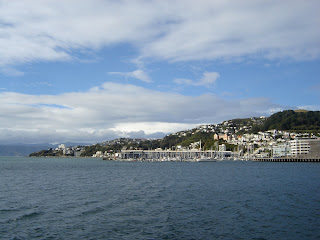
You can see some of the "long white clouds" that New Zealand is so named after in this picture that I took from the harbour in Wellington. Since I work not too far from the waterfront, I take a good number of walks around to take in the views. Even on a windy, rainy day which comes fairly frequently in the New Zealand winter, the sights really are breathtaking.
Friday, June 11, 2010
First full week in Tel Aviv
I just finished my firs t week at the Hotline for Migrant Workers in Tel Aviv, Israel (hotline.org.il). The Hotline for Migrant Workers does much more than answer phone calls from migrant workers - their main mission is (a) promoting the rights of undocumented migrant workers and refugees and (b) eliminating trafficking in persons in Israel. They also have been working a lot recently on behalf of asylum seekers, mainly from Eritrea and Sudan, to get them refugee status.

A sad thing about working in the office is the constant stream of migrant workers and asylum seekers who call and visit, and often the other employees have to explain to them that their hopes to stay in Israel or get a relative or friend released from a detention center are unlikely at best. Many people call the Hotline from prison, and sometimes after the legal department here spends all this time on their case, an unsympathetic judge will declare that it's really not that dangerous in their home county after all, and order a deportation procedure. Israel, which has been the destination of several thousand refugees in recent years, does not have a workable system in place for granting asylum, and many of these refugees have ended up in in detention centers near Tel Aviv or near the Israel-Egyptian border. Sometimes groups of refugees reach the Israeli border and are sent back through the Sinai desert that they just traveled through - and worse, to face the Egyptian border guards who have a policy of shooting refugees to stop them from reaching the border. (link)
Next week I'm going with one of the two lawyers who work here to court to watch his argument for a client who is seeking asylum status, and then on Thursday several other volunteers and I will be trained to interview migrant workers and asylum seekers in a detention center. The goal is to construct a case for them to stay or be released, and sometimes hopefully we will be able to find representative cases that will be useful for changing the law as a whole.
I am learning SO much here - not just about Israeli law and migrant workers but about the political situation in Eritrea, Ethiopia and Sudan (among other countries) and the systems in place for migrant workers in many other places around the world, which we are going to put together as a potential model for revising the Israeli system. Looking forward to the next two months!
 t week at the Hotline for Migrant Workers in Tel Aviv, Israel (hotline.org.il). The Hotline for Migrant Workers does much more than answer phone calls from migrant workers - their main mission is (a) promoting the rights of undocumented migrant workers and refugees and (b) eliminating trafficking in persons in Israel. They also have been working a lot recently on behalf of asylum seekers, mainly from Eritrea and Sudan, to get them refugee status.

So far, I'm having a great time in Israel and at work! Aside from the recent political controversy, my first few days were restful and I have been exploring the city and getting acclimated here. I went to a giant Hebrew book fair, the Tel Aviv Gay Pride Parade (right), and wandered the marketplaces in Tel Aviv and Yafo.
My first night out in Tel Aviv, fliers for prostitutes were left in the windows of my friend's car. I had heard of this but never seen it before - it's illegal in Israel to advertise sexual services in newspapers (partly thanks to the work of the Hotline for Migrant Workers) but it's still allowed when the ad is separate from other materials. (right). Prostitution itself is no longer a crime in Israel, according to my supervisor - the women who are discovered in sex work are given training and help, not treated as criminals. Brothels, however, and the pimps and traffickers that run them, are outlawed. Seeing the fliers made me feel dismayed but also gave me more conviction - there are some major societal problems in Israel and I want to help solve them while I'm here (as much as I can).
One thing I learned that made me proud of our own government is that until the 2000s, trafficking in Israel was rampant and barely mentioned in Israeli law. Then the US State Dept. started classifying countries in three tiers according to the way they dealt with trafficking in their territory, and Israel was in the bottom tier, threatening their U.S. aid. Because of this threat, the Israeli government severely cracked down on human trafficking and raided many of the brothels in South Tel Aviv which were only a few blocks from where our office is located.
 of my friend's car. I had heard of this but never seen it before - it's illegal in Israel to advertise sexual services in newspapers (partly thanks to the work of the Hotline for Migrant Workers) but it's still allowed when the ad is separate from other materials. (right). Prostitution itself is no longer a crime in Israel, according to my supervisor - the women who are discovered in sex work are given training and help, not treated as criminals. Brothels, however, and the pimps and traffickers that run them, are outlawed. Seeing the fliers made me feel dismayed but also gave me more conviction - there are some major societal problems in Israel and I want to help solve them while I'm here (as much as I can).
One thing I learned that made me proud of our own government is that until the 2000s, trafficking in Israel was rampant and barely mentioned in Israeli law. Then the US State Dept. started classifying countries in three tiers according to the way they dealt with trafficking in their territory, and Israel was in the bottom tier, threatening their U.S. aid. Because of this threat, the Israeli government severely cracked down on human trafficking and raided many of the brothels in South Tel Aviv which were only a few blocks from where our office is located.
A sad thing about working in the office is the constant stream of migrant workers and asylum seekers who call and visit, and often the other employees have to explain to them that their hopes to stay in Israel or get a relative or friend released from a detention center are unlikely at best. Many people call the Hotline from prison, and sometimes after the legal department here spends all this time on their case, an unsympathetic judge will declare that it's really not that dangerous in their home county after all, and order a deportation procedure. Israel, which has been the destination of several thousand refugees in recent years, does not have a workable system in place for granting asylum, and many of these refugees have ended up in in detention centers near Tel Aviv or near the Israel-Egyptian border. Sometimes groups of refugees reach the Israeli border and are sent back through the Sinai desert that they just traveled through - and worse, to face the Egyptian border guards who have a policy of shooting refugees to stop them from reaching the border. (link)
Next week I'm going with one of the two lawyers who work here to court to watch his argument for a client who is seeking asylum status, and then on Thursday several other volunteers and I will be trained to interview migrant workers and asylum seekers in a detention center. The goal is to construct a case for them to stay or be released, and sometimes hopefully we will be able to find representative cases that will be useful for changing the law as a whole.
I am learning SO much here - not just about Israeli law and migrant workers but about the political situation in Eritrea, Ethiopia and Sudan (among other countries) and the systems in place for migrant workers in many other places around the world, which we are going to put together as a potential model for revising the Israeli system. Looking forward to the next two months!
Subscribe to:
Posts (Atom)